
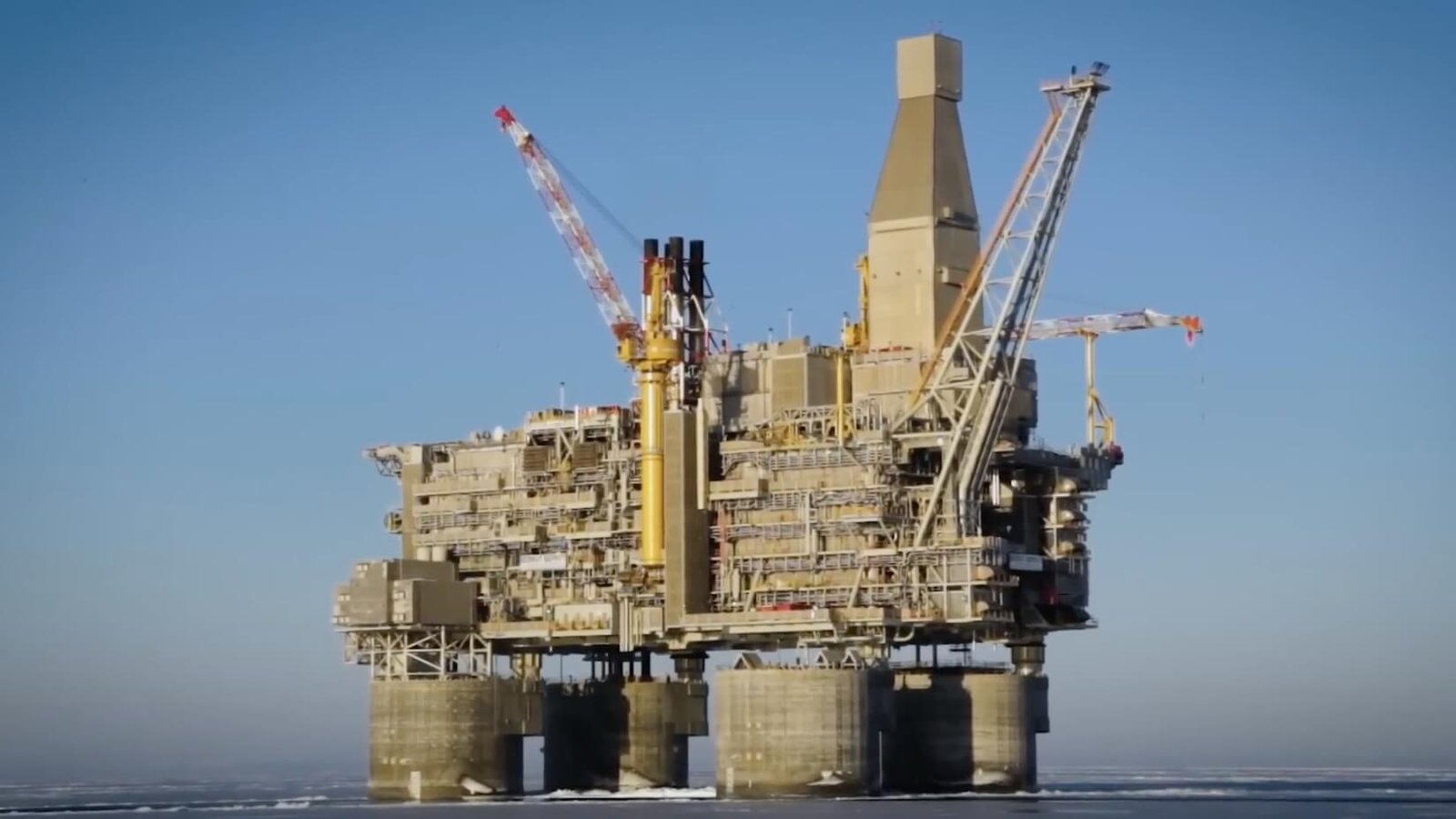
The offshore oil drilling platform Berkut, located 15 miles from Sakhalin Island on the shelf in the Sea of Okhotsk, is one of the largest in the world.
What Is the World’s Largest Oil Drilling Platform?
The Berkut platform biggest oil rig in the world stands as a huge six-story, fully autonomous plant on giant reinforced concrete piles, which not only drills new wells but also simultaneously extracts several thousand tons of oil from a huge depth every day. It’s a real monster with an incredibly complex anatomy.
Berkut Oil Platform Location and Access
When you approach the platform by air, you realize that it really looks like a bird. Berkut means Golden Eagle, but the rig looks more like a fat pigeon which sat down to rest on the surface of the Sea of Okhotsk.
But no real birds are to be found here. It’s too far from the coast. The berkut oil rig location is remarkably remote—it takes 40 minutes by helicopter to reach the rig from the nearest town, by sea 8 hours.
Ships typically deliver equipment and provisions to the platform, and personnel for the next shift arrive by air when the fickle regional weather permits, of course.
Well, what can I tell you about Sakhalin? The island sees nice weather, well, not often, but here on the platform, it’s even more rare. In this kind of fog, for example, a helicopter can’t fly, so sometimes the workers are forced to wait for the weather to change for days or even weeks after the end of their shifts.
Construction and Berkut Oil Platform Size
But how then, here in one of the most inhospitable and inaccessible places on the planet, was it possible to build such a colossal and complex structure weighing more than 200,000 tons? It’s very simple. It wasn’t built here. The platform was brought here piece by piece.
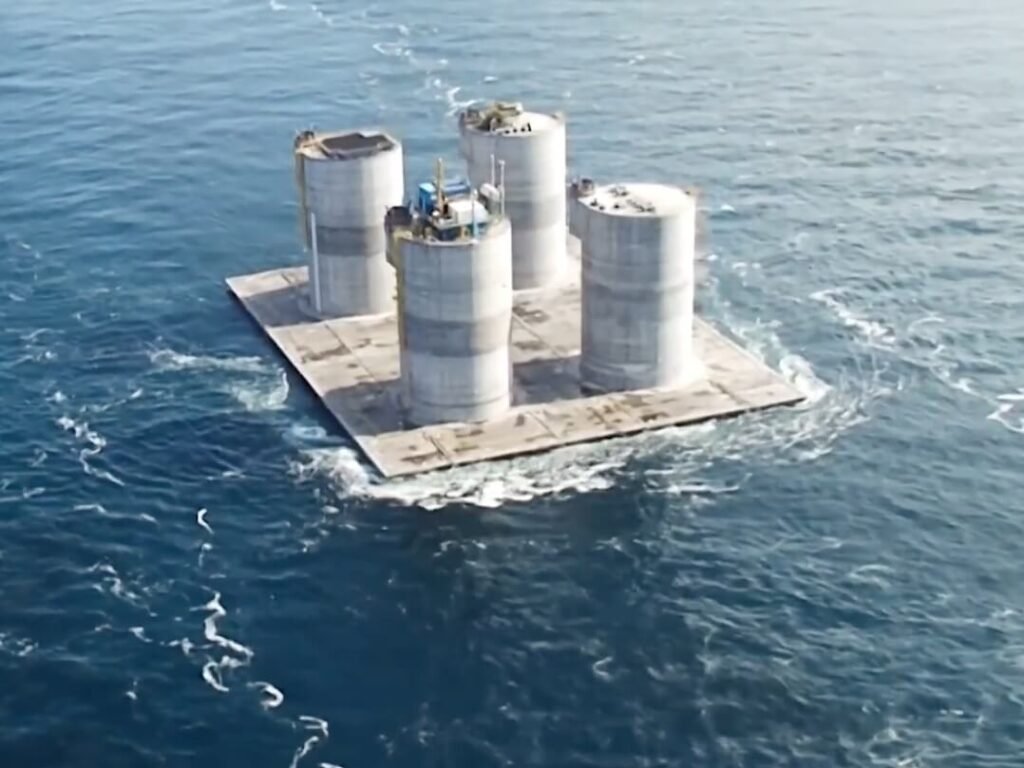
The Berkut oil rig platform is built on a gravity-based structure. That is, unlike floating platforms, it stands firmly on a reinforced concrete foundation which is fixed to the seabed.
The berkut oil rig size is staggering—the base alone weighs 160,000 tons. It was made in Russia, not far from Vladivostok, and towed to this place over 1,200 miles away. Essentially, it resembles an inverted stool.
Once the hollow lower part of the base was flooded with water and the platform sat on the seabed, all that remained was to carefully place the upper part of the platform with all the equipment and the living area on the legs sticking out above the surface of the water.
Ice Protection and Seismic Design
By the way, note that on the middle section of the legs of this giant stool, there is a ring of concrete of a slightly different color. This is the so-called ice protection belt.
The designers calculated that this section of the support is approximately where the 6 feet of ice on the surface of the sea would hit. That’s why the concrete there is of the highest quality. It’s incredibly durable.
Previously, on other similar platforms, such belts were made of steel, but it turned out that the ice often tore the metal sheets from the supports during strong winds or storms. Such an incident cannot happen here under any circumstances.
The Berkut oil rig platform is located directly on a tectonic section, and therefore it was designed to withstand even the most intense earthquakes. That’s thanks to sliding bearings like this one here.
In essence, they work like our knee joints. Below are ball joints, on top, well, let’s call it a patella. In the event of an earthquake, the entire upper part of the platform slides along these supports, thereby dampening vibrations. They say they can withstand up to a magnitude 9.0 quake, but heaven forbid that ever gets checked.
Upper Platform Assembly
The upper part of the platform was made in South Korea. It took several years to build a six-story, high-tech, fully autonomous oil refining complex. At the very end, the structure was crowned with a huge oil derrick, like a Christmas tree topper.
By the way, that was made in Russia in Krasnodar. It was delivered to South Korea by sea, then it was carefully installed on the top of the platform with the help of the world’s only marine crane with a lifting capacity of 7,000 tons, which had to be rented specifically for the operation.
Again, in order to compensate for vibrations during earthquakes, all the pipes and oil wells that go from the upper part of the platform to the lower one have joints here which are covered with black reinforced rubber cuffs.
These couplings allow the pipelines to shift at the connection points relative to their axis and thus provide a guarantee that they won’t burst if something happens.
Safety Systems and Emergency Protocols
However, this is just one of the many ways to protect equipment from unforeseen incidents. What is an oil platform without comprehensive safety systems?
The Berkut oil rig platform, like a huge factory, doesn’t stop working for even one second. It functions day and night because it would take several dozen hours just to start it up again. But you can stop it in an instant with this emergency shutdown button.
When this button is pressed, all the machines stop, all the oil wells are killed, the generators turn off, the circulation of gas and oil stops. In general, the platform completely freezes and goes into damage control mode. This protocol, by the way, is the same for all offshore production platforms, and it was written based on accidents that happened in the past.
Life Safety Capacity
Right now, there are 237 people on the Berkut platform. In general, this figure fluctuates all the time. Specialists come and go, but there is an ironclad rule: there cannot be more than 240 people.
That’s because that’s the maximum number of places in the lifeboats. There are four of them, and it works out to be 60 people per boat. They’re a little larger than an ordinary minibus, which means the passengers are packed in here, well, literally like sardines. But during an actual emergency, as they say, there is no room for complaints. Surviving is what counts.
The lifeboats have never been used, and the same goes for the emergency shutdown button in the central control room. It’s never been pressed.
All of the main parameters of the station’s operation are constantly flowing into this room. From the dozens of graphs and jumping columns on these monitors, the operator draws a conclusion about the condition of the station, just like a doctor draws a conclusion about the condition of a patient’s health by looking at his cardiogram.
By the way, since the staff working on the platform is an international one, all announcements are made in English. Only when the operator understands that a native Russian speaker is answering him can he switch to his native language.
How Does an Oil Platform Work? The Drilling Complex
If the central control room is the brain of the Berkut oil rig platform, its heart is, of course, the drilling site. It’s located at the very top, on the sixth story of the platform. Its lofty position in the structure comes despite the fact that the drill, pipes and the drill bit itself go over a mile under the platform and accordingly deep into the seabed.
In general, offshore drilling is one of the most difficult processes on Earth. Honestly, only space flights are more difficult. Here, on an area of several square feet, you might say that you can find all of humankind’s achievements in engineering.
And if we simplify everything as much as possible, we can say that everything is controlled by this one joystick. It has only four options: higher, lower, faster, and slower. Everything is ingeniously simple.
The Drilling Process
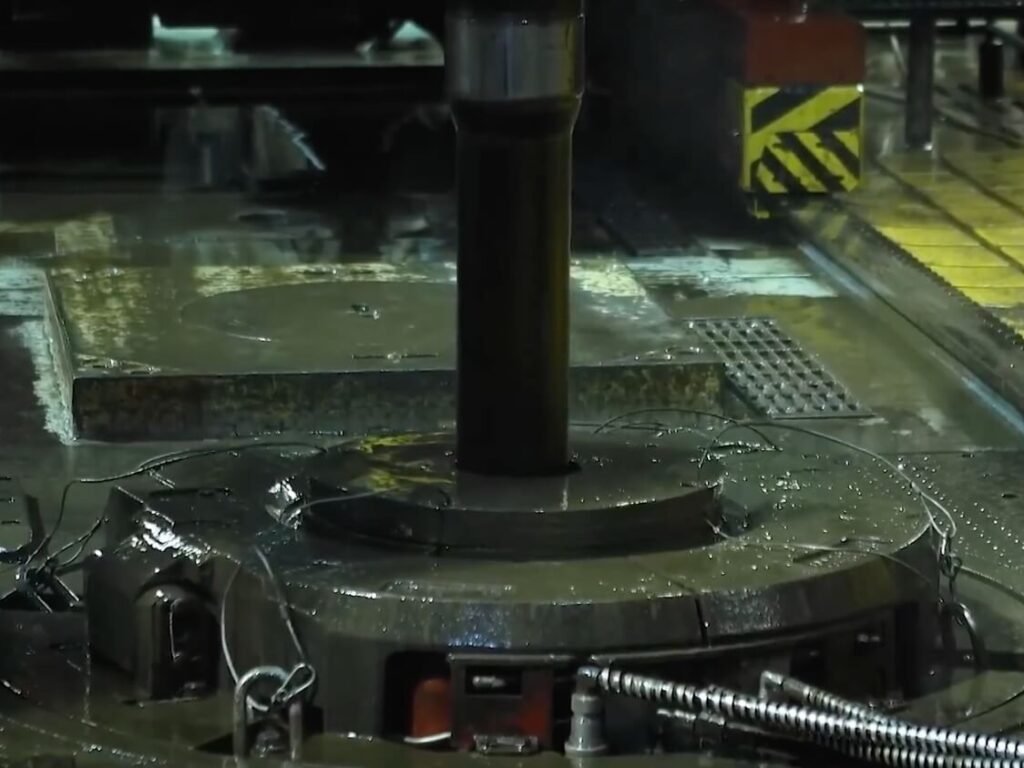
If we go into a little more detail, the joystick controls the manipulator, which in turn pulls out or puts the drilling tool and pipes into the well. They are, more or less, looking for oil by touch.
The Arkutun-Dagi reservoir, on which the Berkut oil rig platform is located, is one of the richest in the Far East. Nevertheless, it doesn’t represent one huge oil bubble. It’s a multitude of large and small cavities filled with hydrocarbons.
Dozens of wells diverge from the platform in different directions underground, sometimes going three or even four miles to one side. Wells, like the mouth of a mosquito, foot by foot, look for oil-filled cavities so that they can then begin to suck it out from them and bring it to the surface. It turns out that under Berkut there’s a whole cluster of wells, and every few months another one is added to the list.
Anyone who has tried to drill into a concrete wall at home knows that it’s best to use drills with serious tips, with special add-ons. Well, here it’s about the same. The drill itself is made of high-strength steel, and the cutting elements are made of artificial diamonds.
This is almost like a piece of jewelry, although it looks pretty brutal. And in case you were wondering, it costs more than a diamond ring, even though these rocks don’t sparkle.
This is how more and more sections of long pipe are screwed on top of the chisel, which rotates. The steel worm at high speeds, the whole construction bites deeper into the rock, going further and further until the drillers find and form a well.
The Doghouse Control Room
The position of the tool is monitored every second by the drilling foreman from this room. It’s called the doghouse by those who work there. Its walls are made of armored, heat-resistant glass and are reinforced with a steel grill on top.
Oil or gas can escape from the well under enormous pressure, and these protective layers can save the lives of those who are inside.
However, this is already a last line of defense. One level below the drilling site, there is a unit that will not, in principle, allow any such incidents to occur. Generally speaking, there aren’t any unimportant machines on the rig, but this one is really one of the most important. It’s called the preventer.
Two knives are installed inside, and in the event of an accident, they simply cut off the well along with the pipe, made, by the way, of high-strength steel, and thereby plug the emergency well. It’s never been used throughout the Berkut oil rig platform’s operation, and hopefully it won’t have to be, but it’s ready to be employed 24 hours a day.
How Do Oil Platforms Work? Production Operations
The preventer is only installed on a well that is currently being developed, that is, where the drill is still looking for cavities of oil under the seabed. And the wells that have already been drilled and handed over to operators are considered to be calm and more or less safe.
The fact is, the pressure in them is already understood, the density and composition of the hydrocarbons is known, and they usually don’t present any surprises. After all that is established, barrel after barrel can be pumped out of here.
The Production Bottleneck
This room can be seen as the narrow bottleneck of the Berkut oil platform, if you like, through which all the oil produced here runs. Each of these thick columns is a well that goes deep under the seabed for up to a few miles.
Then they all converge into one large pipe, and through it the oil is sent off to the mainland. But before that, here, at the sampling stands, a little bit of oil is taken from each well.
Here it is, the black gold of Arkutun-Dagi. It’s more brown, really, sort of reminds you of hot cocoa or something.
The black rubber skirts you see here on the pipes are, again, the same cuffs that are designed to dampen vibrations in case of possible earthquakes and compensate for any deformation. In total, the platform is designed to accommodate 45 wells. To date, about half that number have been drilled.
Waste Disposal Well
There is one unique well on the Berkut oil rig platform which even differs in color. All the others are labeled in yellow, but this one is orange. It’s designated DD-1, and its peculiarity is that there’s no oil inside.
Moreover, the liquid in here doesn’t go up at all, but on the contrary, is pumped down from here. This is filled with drilling waste, dirty industrial water. In short, everything that cannot be dumped into the sea is pumped down this well into a cavity from which oil was pumped out earlier. It’s their rather original way of sweeping dirt under the rug.
This method of disposal, by the way, is considered to be perfectly environmentally friendly. On Berkut, in general, they carefully make sure that no oil products get into the sea. Judging by the giant colony of crabs which has chosen to hang out on the platform supports, and by the fact that sea lions regularly swim on by, they appear to be successful in that.
Pressure Management Systems
But back to the spoils. The safety and operation of the wells through which the oil enters the platform is ensured by equalizing the pressure inflicted on it. The thing is, the pressure on the surface is normal atmospheric, but underground, inside the oil cavities, it’s enormous because miles of earth and water rest on it, pressing on the pocket from above with their weight.
And so, to keep the oil from gushing from the well in a giant fountain, you just need to apply from the surface the exact same amount of pressure that’s felt inside the cavity, that is, equalize it.
Special compressors and hydraulic valves are responsible for this. And this is where the hydraulic valves of the wells are controlled. On the outside, it looks like nothing special, just a bunch of valves.
Life Support Systems
Speaking of bathrooms and fresh water in general, it’s made right here on the platform. Water from the sea is desalinated using this machine. It looks pretty intricate, but in fact, it’s just a reverse osmosis filter, the kind that many of us have under our kitchen sinks at home.
Salt water from the Sea of Okhotsk is pushed under pressure through a membrane that has many holes in it, but the openings are so small that only water molecules can pass through them. Salt and other impurities are caught on the membrane. All that’s left to do is to change the filters on time and to be mindful of water consumption, of course.
Compact Design Philosophy
What is most striking on the Berkut oil rig platform is not the abundance of various machines, but how compactly they are all packed in there. The platform only seems huge for a day.
Then you come to understand that it’s incredibly cramped, because on an area of just one and a half soccer fields, they managed to fit a drilling complex, production complex, a full-fledged oil refinery, residential blocks, a helipad, its own power plant, and even a small in-house chemical production facility.
Chemical Injection Systems
This place is called the chemical injection area. It sounds threatening, but it’s actually quite simple. Experienced homeowners know that you need to periodically add a special powder to your washing machine so that deposits don’t build up in there.
Wells are about the same. Chemicals must be added to them which prevent corrosion from occurring, prevent paraffin from sticking to the pipe walls, and so on and so forth. In general, everything is almost like in that old ad. Remember, “May the platform serve for a long time.”
All units are configured to work independently. The need for human intervention has been purposely minimized. In fact, people here, apart from carrying out the hard physical labor on the drilling rig, mainly fulfill a control function. This, of course, creates a deceptive impression that the platform runs all by itself.
Living Conditions on Berkut
The only place you’re likely to find a crowd on the Berkut oil platform would be in the holiest of holy areas of the structure: the dining room.
Jokes aside, the dining room is one of the most important places on the platform. It works around the clock, and here you can not only eat but also come at any time, for example, for a cup of coffee. And it also performs one other very important function. It is the main gathering place in the event of any abnormal emergency.
Well, and as for the food itself, everything is simple and straightforward. Well, we’ve got, for example, meatballs, pasta, mashed potatoes. Sure, the Sea of Okhotsk, famous for its seafood delicacies, is only about 100 feet below us right now, but there is no crab, no scallops, no sea urchin, nothing like that on the menu.
Everything is filling and safe. At the same time, though, it’s all very tasty and incredibly high in calories. The portion sizes are huge.
Power Generation
Here, in principle, they approach any production on a grand scale, be it oil production or cooking dinner. And all these processes require a huge amount of energy.
Can you imagine how many kilowatts of energy it takes to crank four miles of steel pipe underground that has to follow a complex trajectory and twist around like a garden hose? The platform consumes a huge amount of electricity.
Where to get it all from? For that, Berkut has its own on-site power plant. It consists of four powerful turbines. They run on gas which is produced here. It’s very convenient. You don’t have to worry at all about fuel consumption here.
Each turbine has a power capacity of 15 megawatts. They generate the amount of electricity that would be needed to power half a city like Yuzhno-Sakhalinsk.
At the same time, the entire energy facility is, again, managed by only one person, an arrangement almost impossible to imagine on the mainland, but here it’s simply the way things work.
Working Conditions and Weather Challenges
And although the work at Berkut is incredibly difficult, this is the very case when there are literally no irreplaceable people here. No matter what important position you hold, at the end of your watch, a helicopter will arrive and bring someone who will replace you, again, only when the capricious Sakhalin weather permits it.
There’s almost no wind blowing here now, but sometimes it gusts so hard that this net has to be kept on the helipad. It’s called an anti-slip net, and it’s necessary to keep multi-ton helicopters from simply being blown off of here into the ocean.
So despite the fact that people here live well, as in that very song near where the sun rises, the place is actually quite far from being a romantic one.