
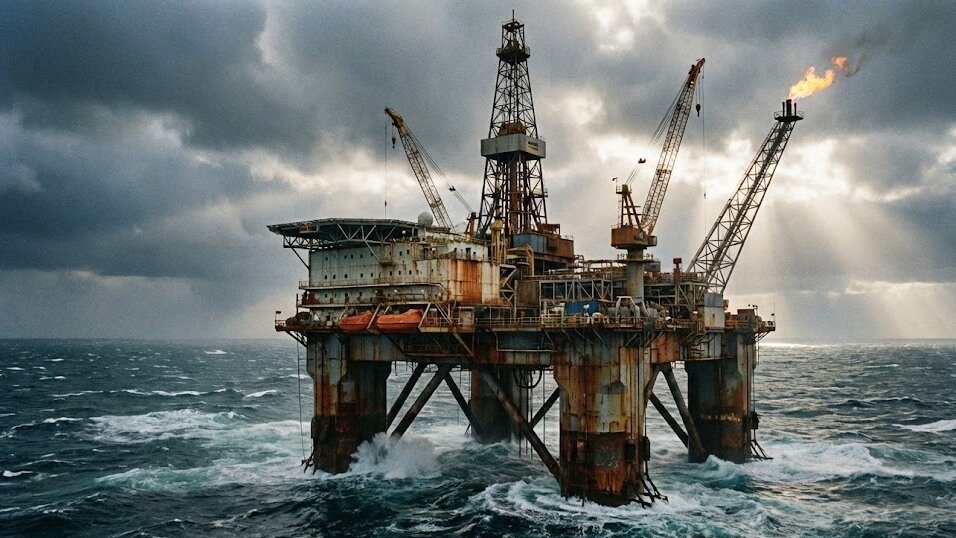
An offshore oil rig, or offshore platform, is a large structure that is used to extract oil or natural gas from the rock beneath the seabed. Understanding what is an offshore oil rig requires looking at the different types used at various water depths and how they function in challenging marine environments.
Types of Offshore Oil Rigs by Water Depth
In deep water up to 1,700 feet, a fixed platform will be used. The platform is held in place by large steel or concrete legs that attach to the ocean floor.
From 1,500 to 4,900 feet, a taller fixed platform called a compliant tower will be used.
For deep water up to 12,000 feet, floating oil rigs will be used. There are several types of floating oil platforms being used. In this guide, we are using a semi-submersible platform as an example.
Semi-Submersible Platforms
This platform is supported on large pontoons. These pontoons provide buoyancy, allowing the unit to float and be towed from location to location.
Some oil rigs are also equipped with propellers under the pontoons. Anchors will be used to secure the rig in the designated spot.
Once on location, the pontoon structure is slowly flooded to keep them below sea level. The work decks float on top of the water, while the vast majority of their mass is below the water surface.
Without the pontoons being submerged under the water, the platform will be unstable when the sea is rough.
Key Components of an Offshore Oil Rig
Now that we’ve covered what is an offshore oil rig and its types, let’s examine the essential equipment found on these platforms:
Hoisting System: Used to raise and lower the drill string.
Cranes: Used for transporting supplies between ships and the oil rig.
Living Quarters: Where crew members stay, eat, and sleep.
Helicopter Pad: Crew members are transported using helicopters.
Emergency Lifeboats: Escape plan for crew members in case of dangerous situations.
Liquid Storage Tanks: Used to store water or fuel, such as diesel.
Diesel Generators: Provide power for the platform.
Flare Stack: Used for burning off flammable gas. Extracted oil might contain gas. This gas must be separated and burned off to avoid any possible explosion.
The Drilling Process: How Oil Rigs Extract Oil
The main purpose of an oil rig is to drill and extract oil from the seabed. Oil lies under many layers of rock underneath the seabed.
Step 1: Lowering the Drill
The hoisting system is used to lower the drill to the seabed. The drill bit is placed inside a large pipe called a casing. The top part of the casing is a wellhead.
Step 2: Drilling Through Rock Layers
When touching the bottom of the sea, the drill starts drilling down. Pressurized water is pumped in to push all the dirt and rocks out of the casing pipe.
When the casing goes down deep enough, it will stay in place and the drill bit will keep going down further.
Step 3: Installing Casing and Cementing
The drill bit will be pulled out of the hole, then a smaller casing will be installed. Cement is pumped down, followed by mud, and a plug is used to separate cement and mud.
The plug is pushed down to ensure the cement covers the outside of the casing and secures it permanently.
This process repeats when drilling down deeper, as the casing gets smaller with each stage.
Blowout Preventer: Critical Safety Equipment
When drilling gets closer to the oil reservoir, a very important device called a blowout preventer (BOP) will be installed on top of the wellhead. This device’s purpose is to prevent any unwanted accidents caused by high-pressure oil coming out of the ground.
Understanding Kicks and Blowouts
Oil may come out with extreme pressure. This is called a “kick.” Kicks can lead to a potentially catastrophic event known as a blowout.
How Blowout Preventers Work
A blowout preventer has two annulars and multiple pipe rams:
Annulars: Designed in a donut shape. When tightened, they can seal the well and prevent oil from coming up.
Pipe Rams: Also used to control pressure or seal the well to prevent oil from coming up.
Blind Shear Ram: Equipped with a steel blade. In case high-pressure oil enters the drill string, this ram closes and the steel blade can cut off the drill string and then seal the well permanently.
Blowout preventers must be tested carefully before being put into use, because any mistake can cause human casualties and environmental disasters, such as oil spills.
Oil Transportation: Subsea Pipeline Networks
When oil is extracted successfully from underneath the seabed, it will be pumped into a pipeline and delivered to facilities on shore. Oil pipelines installed on the sea floor are called subsea pipelines.
There is a whole network of subsea pipelines connecting offshore platforms to onshore facilities. For example, the Gulf of Mexico has an extensive subsea pipeline map connecting numerous offshore oil rigs to shore-based processing facilities.