
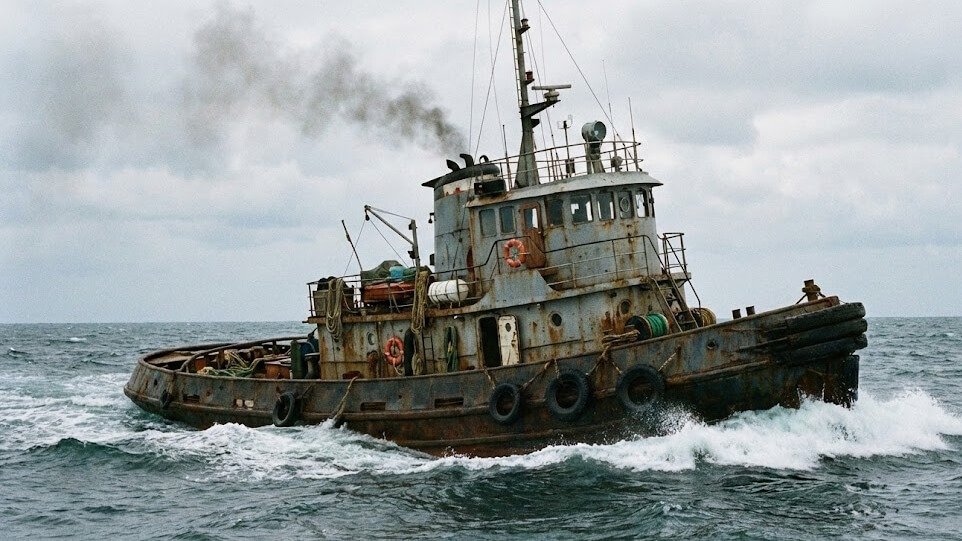
What Is an Offshore Tugboat?
A tugboat is a specialized maritime vessel designed for towing, pushing, or maneuvering other ships. These powerful boats are characterized by their compact size, high maneuverability, and robust towing capabilities.
A tugboat serves as a separate engine to come to the aid of big ships in all directions. A tugboat can tow vessels up to a thousand times its own size due to its powerful propulsion system and water displacement hull design.
Tugboat Propulsion Systems
In this article, we will discussing an average tugboat that we often see at the harbor. In a conventional tugboat, the engines use a fixed propulsion system where they have tail shafts connected to the propellers, and they use rudders for steering.
Modern tugboats today are equipped with azimuth thrusters. They have no rudders, and the thrusters can rotate 360°, making the boat extremely maneuverable.
Z-Drive Configuration
However, the connection from the engines to the propeller is not as simple as one straight shaft. It has to go in a Z shape, which is why it’s called Z-drive.
All the shafts and gears here are very complicated, but let’s view them in a simple way. This includes an input shaft, intermediate shaft, and output shaft. They are connected using universal joints or U-joints. U-joints give the shafts the flexibility to rotate even when they are misaligned. These are the bevel gears.
Now you can see how the torque is transferred from the engine to the propeller. Using bevel gears also allows changing the direction of the propulsion unit without interrupting the spinning cycle of the shaft. Steering gears are utilized to alter the direction.
Clutch System
There are many different types of clutches. The clutch is very important because it separates the engine from the drive shaft. So when the engine starts and rotates, the clutch remains disengaged and the boat stays still. When the clutch is engaged, that is when the boat is able to move.
Kort Nozzles
Kort nozzles increase efficiency by reducing the amount of water swirling around the propeller. This redirection of flow can lead to higher thrust for a given amount of power input.
How Much Power Does a Tugboat Have?
An average tugboat can produce up to 3,400 horsepower, and a large tugboat can produce up to 27,000 horsepower. A tugboat can work alone or in a team.
Tugboat Components
Let’s go over the design and some main components of a tugboat. The wheelhouse has a 360° view so the captain can see all of the surroundings.
Towing winches: One in the front and another in the back.
Mechanical arms: They are like small cranes and used for various purposes.
Tire fenders: They provide cushioning for impact absorption when pushing the hull.
Tugboat Water Displacement Hull Design
The whole design of the tugboat must be a water displacement hull. Let me explain why this is so important.
On land, when a truck tows something bigger, it requires a good grip on the ground surface to be able to pull. In the ocean, a tugboat’s hull has to submerge under the water surface to be able to pull. It might sound strange, but it is like having a good grip on water to pull something.
In the same size boat with a planing hull, which is designed for the boat to slide on the water surface when accelerating, if this boat were to tow something bigger, it would fail.
On the contrary, a tugboat’s water displacement hull is designed in a more curvaceous shape like a bowl, featuring a fin keel. This design enables the tugboat to submerge beneath the water surface when running at high thrust power.
Now you can see that the combination of strong thrust power and a water displacement hull design enables a tugboat to tow a ship a thousand times its size. Not only the shape of the hull, but the steel frames inside the hull also contribute to the weight that helps submerge the boat.
Living Quarters and Crew Accommodations
The living quarter that provides essential amenities for the crew to use during long towing operations. In a bigger tugboat, it is equipped with extra rooms and beds in case it has to carry out a rescue mission rather than just towing.
In another case, some very small tugboats don’t even have a restroom, so the crew might have to handle their personal needs elsewhere.
Tugboat Towing Operation
In a towing operation, the hawser, which is a large rope, is connected to the large vessel using either the front winch or rear winch, depending on each towing task.
For example, the tugboat approaches the bigger vessel to connect the hawser from the rear towing winch to the bollards of the bigger vessel. To do this, the crew on the deck of the bigger vessel throws down a rope called the messenger line. The crew in the boat locks the messenger line into a bight, which is the loop at the end of the hawser.
Now the crew can pull up the hawser. The bight of the hawser is placed over the bollard. Now the tugboat is ready to tow the vessel.
After the towing is done, the crew on the ship will carefully send the hawser back to the tugboat in the same way using a messenger line rope.
Is Working on a Tugboat Dangerous?
Ropes with tension on the deck are more dangerous than they look. During towing operations, the hawser can be very tight and has the possibility to break.
Therefore, on deck there are snapback zones. This is where any crew member should never stand during towing or mooring to avoid serious injury or casualty.
In another situation, when a strong wind pushes a larger ship, it can end up pulling the tugboat instead of being pulled. This can potentially cause the tugboat to capsize and flip over.
To prevent this, the crew must manually cut the rope. It is crucial for the crew to avoid the snapback zone while performing this task to ensure safety.
Understanding what is a tugboat used for helps appreciate the critical role these vessels play in maritime operations, from harbor maneuvering to emergency rescue missions.