

Offshore pipelines are a critical component in extracting, processing, and transporting offshore oil and gas from deep offshore to a shore facility. The job of a pipelay barge is simply to lay a pipeline on the seabed from point A to point B. The laid pipeline can be either on the seabed or hanging from a bow string. Understanding offshore riser installation is essential for successful pipeline-to-platform connection projects.
This article discusses offshore riser installation from the point of view of an offshore surveyor—what the surveyor needs to know and do during a riser installation.
What Is an Offshore Riser?
Let us understand first: what is an offshore riser? A riser is simply a portion of a pipe that connects to the laid pipeline on the seabed and rises up above the water up to the platform. There will be connectors and valves to connect the riser to other internal pipes, which takes it further for processing.
Types of Risers in Offshore
Risers can be mainly of three types: rigid risers for the rigid pipelines for offshore platforms; flexible risers are mainly used for SBM, FPSO, and floating platforms; another is a hybrid riser, which is a mix of flexible and rigid pipes.
But the job of the risers are exactly the same—it is the connection between the pipeline on the seabed and platform or some other facility to transport oil and gas from one place to another.
Now, there can be another type of riser used in the floating drilling rig. It is called a marine riser. It connects the rig with the BOP on the seabed, and drilling pipe is lowered through this marine riser.
Offshore Riser Installation Steps
There are some prerequisites for offshore riser installation that need to be completed beforehand.
Step 1: ROV Survey
First, we need to know where is the end of the pipeline and lay of the pipeline with respect to the face of the platform where the riser is going to be installed. During the pipelay, the end of the pipeline is laid at a predetermined location, but a lot of time this predetermined target box is either overshot or undershot. So a simple ROV survey is necessary to understand where the pipeline end is.
Step 2: Riser Clamp Installation on Jacket Platforms
As the riser needs to be fixed on the platform, a set of clamps needs to be installed on the jacket members to hold the rigid riser pipe. So before offshore riser installation begins, the barge must have the riser clamps installed on the platform.
Step 3: Measuring Pipeline-to-Riser Base Distance
Next, you need a very accurate distance measurement from the end of the pipeline to the riser base. Riser base is the point on the seabed where the riser rises vertically. Now, you cannot have a 90° bend in the riser pipe, so the riser pipe will be rounded.
To measure the distance in shallow, clear water, normally divers will carry out a metrology, and in deeper and inhospitable water, LBL will be used to measure this distance. Have you heard of LBL metrology? It is very common in offshore riser installation projects.
Step 4: Spool Installation
Now you have a pipeline segment and you have a riser segment. Sometimes you need to add some additional piece of pipe between them to connect them together, and these are called spools.
Depending on the distance and face of the platform and lay of the pipeline on the seabed, the spool is designed and lowered to the seabed and connected to the pipeline using valves and bolts.
Sometimes the entire spool and riser segment is prepared on board a barge. The pipeline end is lifted out of the seabed using multiple deck cranes, and the riser segment along with spool is welded to the pipeline end. And then slowly, the entire pipeline, spool, and riser is lowered back into the water and the clamps tightened.
So that is a short description of how the riser is installed.
What Does a Surveyor Do During Riser Installation?
What does a surveyor have to do? What help can a surveyor provide during offshore riser installation
Now that we have a fair idea how a riser installation is done, let us concentrate on what are the sequence of events and where a surveyor can help and assist the barge people, and what a surveyor needs to do.
Barge Approach and Positioning
For offshore riser installation, a barge has to approach the platform site first. In the barge, there will be at least five aids at one side of the barge.
Always remember to position the barge keeping the side of the derrick towards the pipeline side, so the barge will be positioned parallel with the pipeline—it’s about 2 to 3 meters away from the pipeline.
Diver Metrology and USBL Positioning
Next, as a critical step in offshore riser installation, the divers will go down and carry out a metrology. Divers might ask for a USBL beacon to help position themselves and to find the pipeline, so you need to carry out a USBL positioning for that. You need to carry out a USBL calibration.
Riser Fabrication Based on Metrology Data
Once the metrology is done, that data will be forwarded to the field engineer and the welding foreman, and they will construct a riser piece—a bend piece that will be connected with the pipeline and a straight piece that is coming up towards the platform.
As the riser piece is being manufactured on board the vessel, on board the barge, the divers will go down again and all the derrick hooks will be lowered into the water. And the derricks will be connected onto the pipeline.
Installing USBL Beacons on Derrick Hooks
There may be a case where you may have to install at least five beacons on various hooks of the derrick that is connected to the pipeline. This is utmost important. This is required for you to find out the profile of the pipeline as the pipeline is being lifted from the seabed.
As this is very important, you need to know what is the USBL beacon depth. So when you are calibrating and operating the USBL system, you must make sure that the USBL beacon is giving you the correct depth from the surface of the water, not from the transducer to the beacon.
Pipeline Lifting and Profile Monitoring
Now that the USBL beacons are connected to the derrick hooks and derrick hooks in turn are connected to the pipeline, the barge will also use a Nemo—a pneumatic depth sensor—onto the derrick hooks.
For them, it’s a backup to know the pipeline profile. And they will slowly start picking up the pipeline, and the pipeline will be not straight up—it will be inclined. The stern-most derrick will pick up more, and the bow-most derrick will pick up a little less, so the pipeline profile is like that. This is towards the stern.
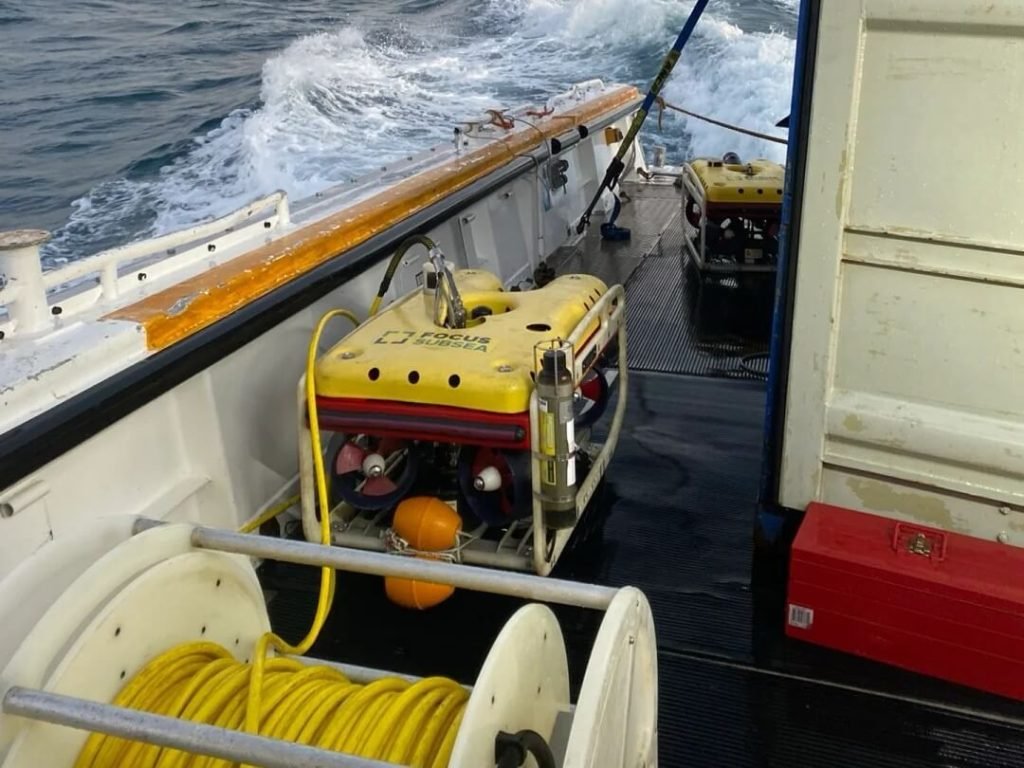
And the pipeline is going down in a slant profile. You have to make sure that the profile is good, and to check the profile, it may happen that the barge may launch ROV to fly along the pipeline profile to have a visual confirmation.
Securing and Cutting the Pipeline End
Once the pipeline end or the pulling head of the pipeline is above the water, the barge will use a bear clamp to hold the pipeline end or the pulling head, and they will cut off the pulling head portion.
Welding Riser to Pipeline
Next, the big rig will pick up the riser from the deck, and they will weld it onto the pipeline using the bear clamp to align them together. And there will be usual NDT, X-ray, and wrapping done on the weld joint.
Lowering and Aligning the Riser with Platform Clamps
Once everything is ready, they will slowly put the pipeline down on the seabed and try to pull it from the platform end so that the riser end is aligned with the clamps that are already installed on the platform. And once the risers—the complete pipeline riser—are aligned with all the clamps, they will simply close the clamp and complete it.
And that completes the offshore riser installation process from the surveyor’s perspective. This is how offshore riser installation is executed on board the vessel.
Offshore riser installation requires careful planning, precise measurement, and coordination between surveyors, engineers, and installation crews.