
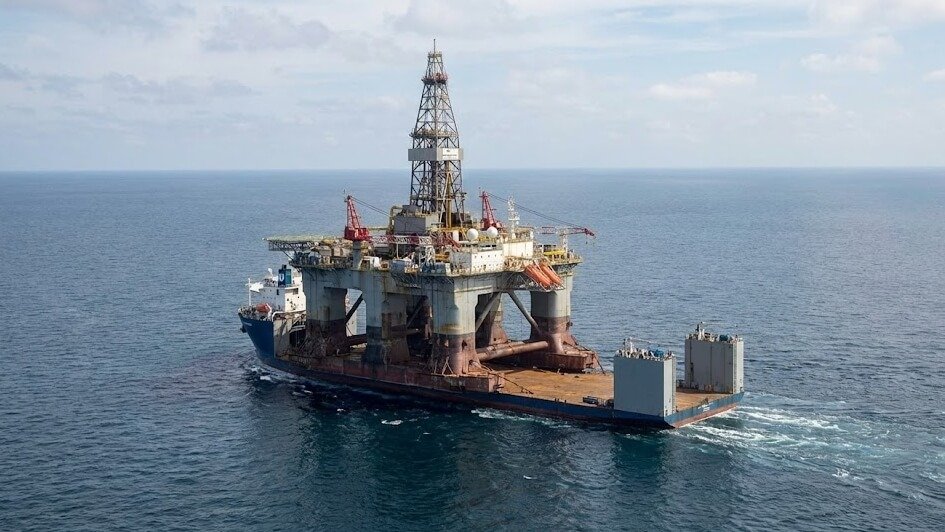
Are oil rigs moveable? Yes, most drilling rigs are designed to be relocated, though the transportation method depends on their size, design, and whether they have self-propulsion capabilities.
How Are Oil Rigs Transported?
Oil rigs are transported by a semi-submersible vessel, which is a special type of ship designed to lift and carry giant structures. It can submerge itself, allowing the cargo to float above its deck, and then rise back up, lifting the structure clear of the water for transport.
In this example, our ship is tasked with transporting two offshore oil rigs from different locations, one after another, over a long distance.
Let’s explore how this incredible vessel works and how both the ship and the oil rigs cooperate to complete this mission.
Semi-Submersible Vessel Design
The ship’s superstructure is located at the bow, while the entire midsection forms a vast open deck for carrying cargo with an area of more than 93,600 square feet in this model. However, deck sizes vary depending on the ship’s design. At the stern, you can see two buoyancy towers that help maintain stability when the ship is partially submerged.
Ballast Tank System
Inside the hull, the space is divided into multiple ballast tanks. When seawater is pumped into these tanks, the ship becomes heavier and slowly submerges below the waterline. The ballasting process can take many hours, often carried out overnight, so that by early morning the flotation operation can begin in daylight when visibility is best.
Ballasting is done step by step, constantly monitored to keep the ship perfectly balanced, avoiding trim and list and the risk of capsizing. At each stage, stability is checked and adjustments are made carefully to prevent uneven weight distribution. The goal is to sink the ship under the waterline, not to the bottom of the ocean.
Propulsion and Power Systems
This ship is powered by our-stroke marine diesel engines. Because much of the hull is occupied by ballast tanks, the engines cannot connect directly to the propellers. Instead, they operate as generator sets producing electricity to power electric motors that drive each propeller.
This ship has side thrusters at the bow and stern that help it move sideways for precise positioning.
Cargo Deck Structure
The cargo deck is made from thin, high-strength steel plates supported underneath by a lattice framework of beams. This creates a very stiff and lightweight structure capable of supporting massive loads.
Before loading, wooden cribs are placed on the deck to prevent direct metal-to-metal contact between the giant cargo and the deck plates. At the same time, they distribute the weight of the cargo evenly across the ship’s structure.
Preparing Oil Rigs for Transport
An offshore oil drilling rig is typically semi-submerged in operation for stability. It achieves this by flooding its pontoons with seawater.
To prepare for transport, the rig must float higher by pumping water out of its pontoon tanks. Each pontoon is divided into multiple balanced tanks, allowing careful control of buoyancy and balance. This procedure must be monitored very closely to prevent the rig from capsizing.
Understanding how are oil rigs transported begins with this preparation phase.
Loading Operations with Tugboat Assistance
With both the vessel and the oil rigs ready, tugboats tow the rig into position above the submerged deck. They manage not only towing but also mooring lines to keep the rig perfectly aligned.
Even a small misalignment can cause serious stress once lifting begins. This is another reason why this work is done during daylight hours.
Deballasting and Lifting
Once the rig is in place, the ship begins deballasting, pumping seawater out of its ballast tanks to rise. This process must be calculated carefully as the ship now carries the enormous weight of the oil rig on its deck.
As the vessel rises above the waterline, the rig settles securely onto the wooden cribs, ready for fastening and safe transport.
Multiple Rig Transport Operations
After the first rig is loaded, the ship sails to the next location and repeats the same procedure: ballasting to submerge, then deballasting to lift the second rig.
Self-Propelled Rigs
Some oil rigs are equipped with their own propellers beneath the pontoons. These self-propelled rigs cannot be transported by a semi-submersible vessel, and instead they must be towed over long distances.
Offloading at Destination
Upon reaching the destination, the vessel once again ballasts, taking in seawater to submerge the deck. As it sinks below the waterline, the oil rigs begin to float freely. Tugboats then guide each rig away safely, completing the operation.
This complex process of how are oil rigs transported demonstrates the sophisticated engineering required to move these massive offshore structures.
The combination of specialized semi-submersible vessels, precise ballasting systems, and tugboat assistance shows how is oil transported when dealing with structures weighing thousands of tons across vast ocean distances safely and efficiently.