
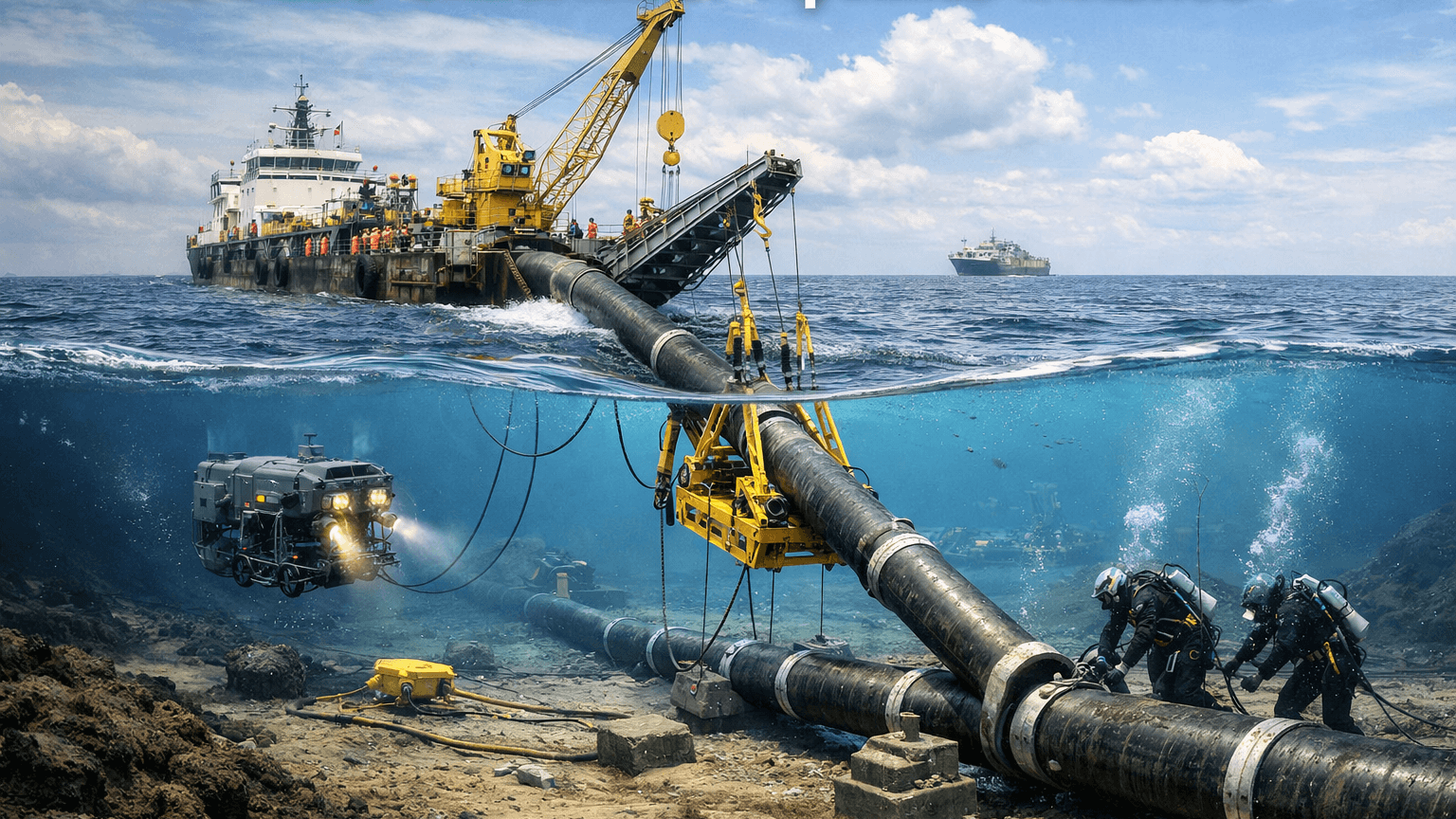
A subsea pipeline, also known as an offshore pipeline, is a length of pipe that is laid on or below the seabed. It is used to transport oil or gas across long distances. Under the dark bottom of the sea, there exists an extensive network of subsea pipelines. In this article, we’ll break it down and explore what comprises this network and how subsea installation works.
Simplified Subsea Pipeline Systems
Let’s begin with the most simplified perspective before looking into the more complex aspects. The wellhead is where oil or gas emerges from the ground. The pipelines that transport the oil or gas to processing facilities onshore or offshore are called flowlines, also known as production pipelines or infield pipelines.
Export pipelines are responsible for transporting processed oil or gas from the production platform to onshore and offshore facilities. Transmission pipelines carry oil or gas from one coast to another, primarily for trading purposes.
However, that’s an oversimplified view of subsea pipelines.
Subsea Pipeline System Components
In reality, there’s no such thing as one straight pipeline that handles everything. It actually involves a comprehensive system with multiple interconnected components.
Let’s examine the system starting from the well where oil emerges. When a newly discovered reservoir is tapped, oil flows out under extremely high pressure. A subsea tree is installed to regulate pressure and control the flow of oil.
A jumper connects and transmits oil from the subsea tree to a production manifold. In a typical setup, there may be six wells connected to one manifold.
The production manifold collects and directs fluids from multiple wells into one or more flowlines.
The PLET (Pipeline End Termination) serves as the connection point between two pipes.
PLEM (Pipeline End Manifold) is similar to PLET, but it can connect and distribute the flow from more than two pipelines.
A subsea boosting pump may be installed when a reservoir has low energy or insufficient pressure. The pump station increases the flow rate to maintain production efficiency.
From the manifold, the flowlines connect to vertical pipes known as risers, transporting oil upward to the production platform.
Subsea Pipeline Power and Control Systems
All of these subsea installation components require power to function. Without power, they would be nothing more than useless metal structures on the ocean floor.
To provide power to this equipment, a large cable known as an umbilical is installed. Inside the umbilical, there are several components that serve different functions: high voltage cables, electric cables, fiber optic cables, chemical fluid lines, and hydraulic fluid lines.
The umbilical connects to an SCM (Subsea Control Module), which then connects to the SDU (Subsea Distribution Unit), distributing power and control signals to the rest of the subsea system.
Expanding the Subsea Pipeline Network
Let’s expand the network to include new drilling locations in the vicinity. A production site may have multiple flowlines connected to more than one platform to increase production capacity.
Alternatively, a flowline can connect directly to an onshore facility. In some cases, to save costs from building a new processing facility, a subsea tieback is used—a process that connects a new production site to an existing platform infrastructure.
Export and Transmission Pipelines
Moving on to export pipelines: if each platform had to build its own export pipelines to reach onshore facilities, it would result in significantly higher costs.
Instead, there is typically a main export pipeline, and each platform connects to it through branch lines. Export pipelines not only transport oil to onshore facilities but can also transport oil to FSO (Floating Storage and Offloading) vessels and oil tankers.
For transmission pipelines, multiple lines from various starting points may merge into a single transmission line and then split into multiple lines leading to different destinations.
Now you have an overview of what a subsea pipeline network entails and how these systems interconnect to form the infrastructure for offshore oil and gas transportation.
Subsea Pipeline Installation
How are underwater pipelines installed? Let’s examine how these pipelines are installed beneath the ocean.
Subsea ROV
In shallow water, human divers can perform installation work, but how are underwater pipelines installed in the deep sea? ROVs (Remotely Operated Vehicles) serve as the primary workforce. Subsea trees, manifolds, and other large equipment are lowered to the seabed using cranes from specialized vessels. ROVs assist in precisely positioning these devices on the seafloor.
The physical dimensions of these devices are substantial—often several meters in height and width. Jumpers, which are short connecting pipes, can also be lowered using cranes. ROVs then plug in the necessary cables and hydraulic connections to complete the installation.
Seabed Preparation and Survey
Before laying a very long pipeline, the sea floor needs to be thoroughly scanned and analyzed.
The seafloor surface is not always flat and uniform, so selecting the optimal path for pipeline installation is critical. Seabed preparation activities, such as trenching and rock placement, are essential to create a suitable surface for laying the pipes.
This process is similar to earthwork performed on land, except it takes place underwater and must be executed using various types of remotely operated vehicles.
What Are the Methods of Pipeline Installation?
There are two main types of pipeline installation methods used for subsea pipelines underwater: towing installation for short pipe sections, and S-lay and J-lay methods for laying very long pipelines.
Subsea Pipeline Installation S LAY
Let’s focus on the S-lay method, which is one of the most common subsea pipeline installation methods.
A long pipeline consists of many shorter pipe segments welded together. For example, a typical pipe segment has a length of 12 meters and a diameter of 1 meter, made of steel and coated with reinforced concrete for protection and weight.
The concrete coating gives the pipeline its characteristic appearance on the seafloor. Individual pipes are carefully welded together, and the welds are inspected and coated to ensure there will be no possibility of leakage.
Subsea Pipeline Laying Vessel
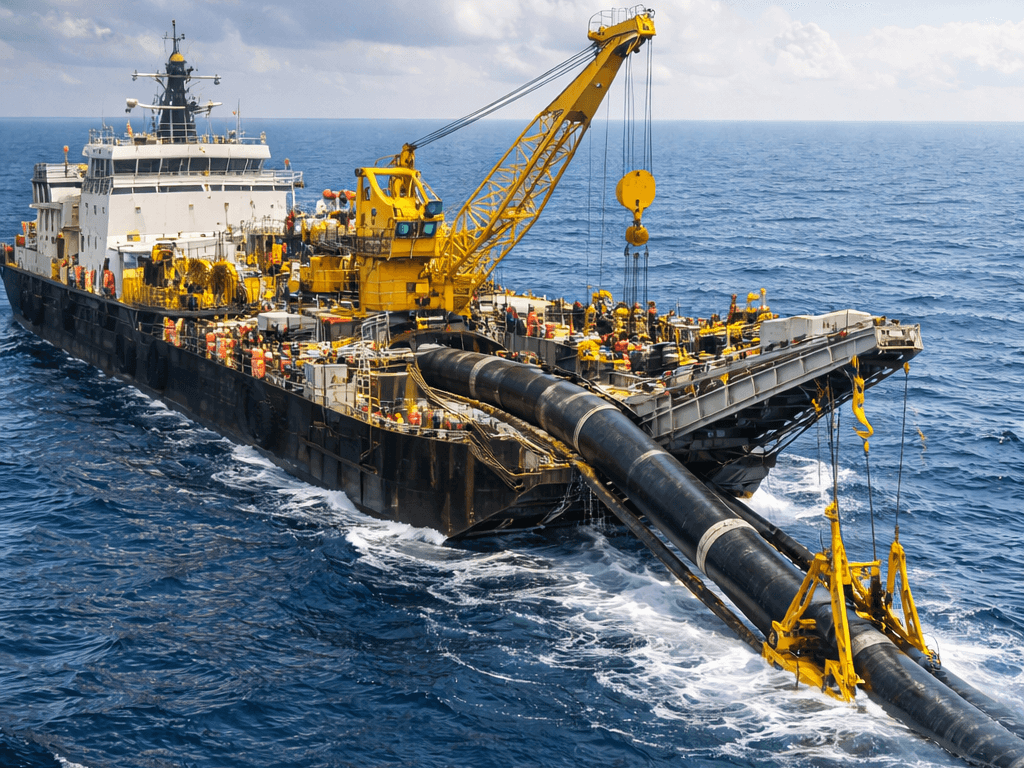
The installation uses a specialized pipe laying vessel. Pipes are manufactured onshore and loaded onto the vessel. Supply ships constantly deliver additional pipes to maintain continuous operations. Each pipe segment is welded to the previously laid section and then slowly lowered to the sea floor in a controlled manner.
Once subsea HDPE pipeline installation or steel pipeline laying begins, the vessel must continue operations until construction is completed. This means there can be no extended breaks, even if the vessel encounters storm conditions.
If the vessel halts for too long, the suspended pipeline might break and collapse due to excessive tension and bending stress.
The touchdown point—where the pipe contacts the seafloor—is positioned near the previously laid pipeline section. The final pipe section is measured, cut to the required length, and then connected using mechanical connectors or underwater welding methods to complete the tie-in.
Umbilical cables are laid from a cable-laying ship equipped with a giant spool that pays out the umbilical as the vessel moves along the planned route.
Subsea Pipeline Repair and Maintenance
Pipelines are subject to external damage over time and require repair when integrity is compromised. The subsea pipeline repair process begins with lifting the damaged section using subsea cranes or specialized lifting equipment.
Repair clamps are installed around the damaged area, and holes are drilled into the pipe to allow access. A bypass pipe is installed to redirect the flow of oil around the damaged section. Valves on either side of the damaged area are closed to isolate the section and stop the flow of oil.
The oil remaining inside the damaged section is flushed out completely. The damaged pipe section is then cut out and replaced with a new section. After the repair is completed and inspected, the isolation valves are opened to restore normal oil flow through the repaired pipeline.
Conclusion
How are underwater pipelines installed? Understanding subsea installation and how subsea pipelines are laid provides insight into the complex infrastructure that supports global energy transportation. From subsea pipeline design, analysis, and installation through to subsea pipeline commissioning and eventual maintenance, every phase requires specialized expertise.
The subsea pipeline engineer’s salary reflects the technical complexity of this work, as professionals in this field must master multiple disciplines, including structural engineering, fluid dynamics, and deepwater operations. Whether working on new subsea pipeline installation methods or conducting subsea pipeline repair, these systems represent some of the most challenging engineering achievements in the offshore energy industry.